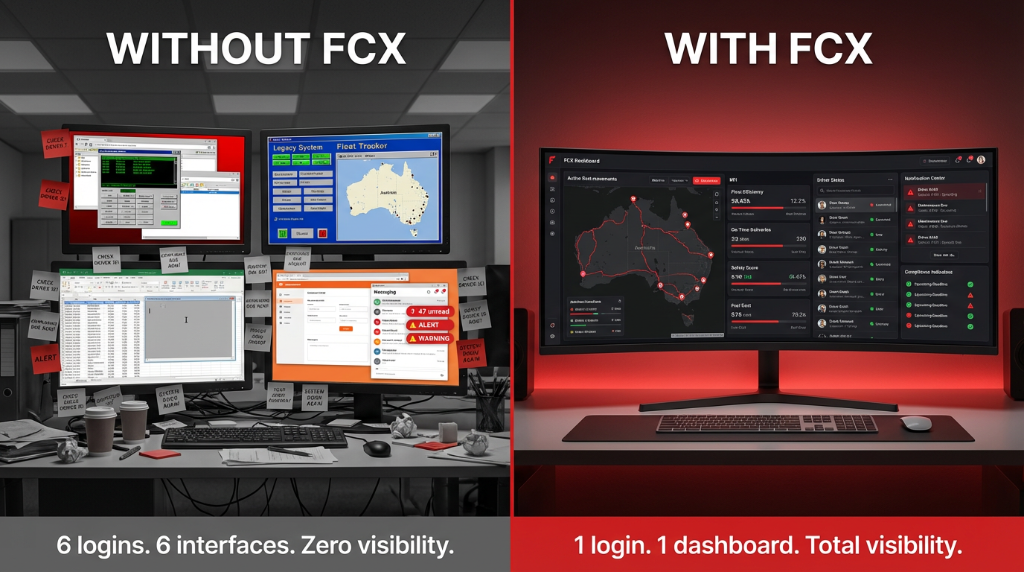
The transport industry has changed. Most TMS systems have not. The result is fragmented, reactive and unsafe operations across Australia.
Transport operators today face increasing pressure from rising compliance requirements, driver shortages, higher operating costs, customer expectations for real-time visibility and increasing safety and regulatory obligations.
Yet the systems most businesses depend on were built for a different era. They were designed to record information after the fact, not to actively support the complexity of modern transport operations.
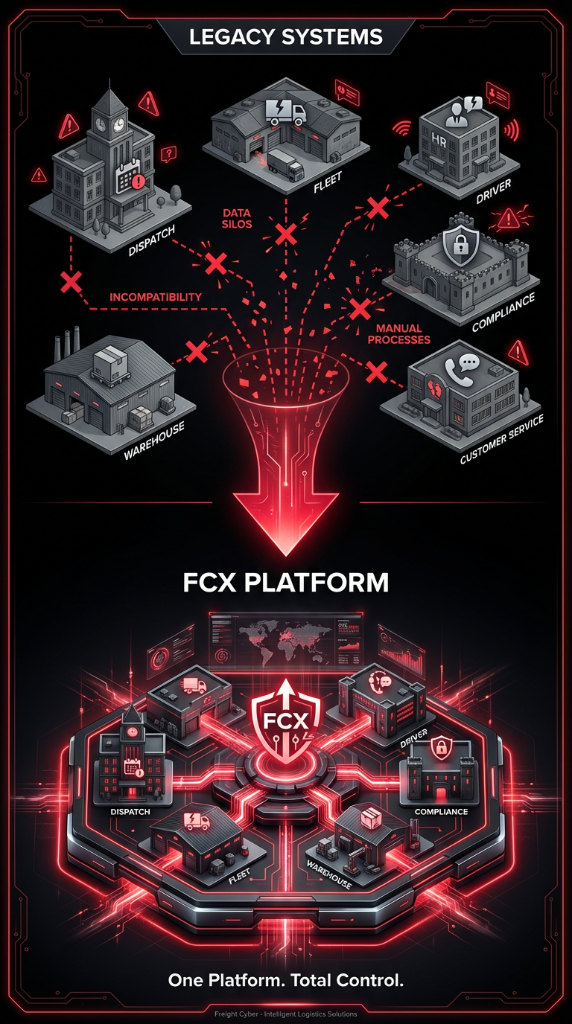
Many transport businesses operate using multiple systems for dispatch, fleet, compliance, warehouse management and customer communication. These systems rarely integrate properly, creating operational silos and manual workarounds that consume time and introduce errors.
When a driver completes a job in one system but the warehouse has not been updated in another, the result is miscommunication, delays and missed service expectations. The business pays the price in cost and reputation.
Most legacy TMS platforms were designed to record information after the job is done. They function as digital filing systems rather than operational tools. Dispatchers still make decisions based on phone calls and whiteboards because the system cannot provide the live operational context needed to act quickly and accurately.
When every operational decision requires leaving the system and calling someone, the system is not running the business. It is documenting what the business has already done.
Drivers are the backbone of the transport industry, yet many legacy systems provide minimal support to the people actually doing the work. Drivers rely on paper run sheets, phone calls from dispatch and personal knowledge of routes to do their jobs safely and compliantly.
Legacy systems often fail to deliver clear job instructions, real-time communication, safety alerts, fatigue and compliance monitoring, easy-to-use mobile tools and chain of responsibility support. A business with great systems in the office but nothing in the cab is operating with a fundamental gap in its compliance and safety framework.
In most legacy environments, managers and executives can only see what happened yesterday. Reporting is delayed, incomplete and often requires manual data extraction from multiple systems. Real-time visibility across jobs, fleet, compliance and financial performance is simply not available.
Without live operational data, decisions are made based on assumptions, experience and instinct rather than facts. This increases cost, increases risk and limits the ability to respond to problems before they escalate.
As transport businesses grow, their operational complexity increases. They take on more customers, more subcontractors, more vehicles and more regulatory obligations. Legacy systems, built on outdated architecture and designed for simpler times, cannot scale to meet this complexity.
Integrating new modules, automating new workflows or adopting AI and machine learning capabilities is either impossible or prohibitively expensive. The system becomes a constraint on growth rather than an enabler of it.
See the difference one connected operating system makes across your entire operation.
| Capability | ✘ Legacy Systems | ✔ With FCX |
|---|---|---|
| System Integration | Multiple disconnected systems | One connected operating system |
| Operational Visibility | Delayed, incomplete reporting | Real-time across entire operation |
| Driver Support | Paper-based, phone calls | Full mobile operating system |
| Compliance Management | Manual, reactive | Embedded and automated |
| Intelligence and AI | None | AI embedded across all workflows |
| Fatigue and EWD | Separate system or paper | Built into FCX Drive |
| Fleet Maintenance | Reactive, scheduled | Predictive and connected to dispatch |
| Customer Visibility | Phone and email only | Dedicated customer portal |
| Dangerous Goods | Manual processes, risk of gaps | Fully integrated compliance module |
| Scalability | Limited, costly to expand | Built to scale with the business |
It needs an operating system.
Legacy systems are fragmented, reactive, not driver-focused, not intelligent and not scalable. They were built for a different era of transport operations. Attempting to patch them with additional modules or integrations only adds more complexity to an already broken architecture.
The answer is not to add more software. The answer is to replace the entire fragmented environment with one connected, intelligent operating system built specifically for the Australian transport and logistics industry.
That operating system is FCX.